
What a trim around here usually covers
- Dead limbs. Big pines shed dead lower branches, and oaks carry dead wood in the crown. After the dry spring of 2026, there is more of it than usual. These are the limbs that come through roofs and windshields in the next thunderstorm.
- Roof and gutter clearance. Branches resting on shingles scrape them in wind and keep the roof damp. Overhanging limbs also fill gutters with needles and leaves.
- Driveway and street clearance. Raising the lowest limbs so trucks, campers and school buses pass under them.
- The service drop. On a wooded Villa Rica lot, the wire feeding the house often threads through the canopy. How that is handled is covered below.
- Storm-hung limbs. Broken branches caught in the crown after a storm, called hangers, which can drop without warning.
Good cuts and bad ones
Ask the contractor how they will cut, and listen for these points:
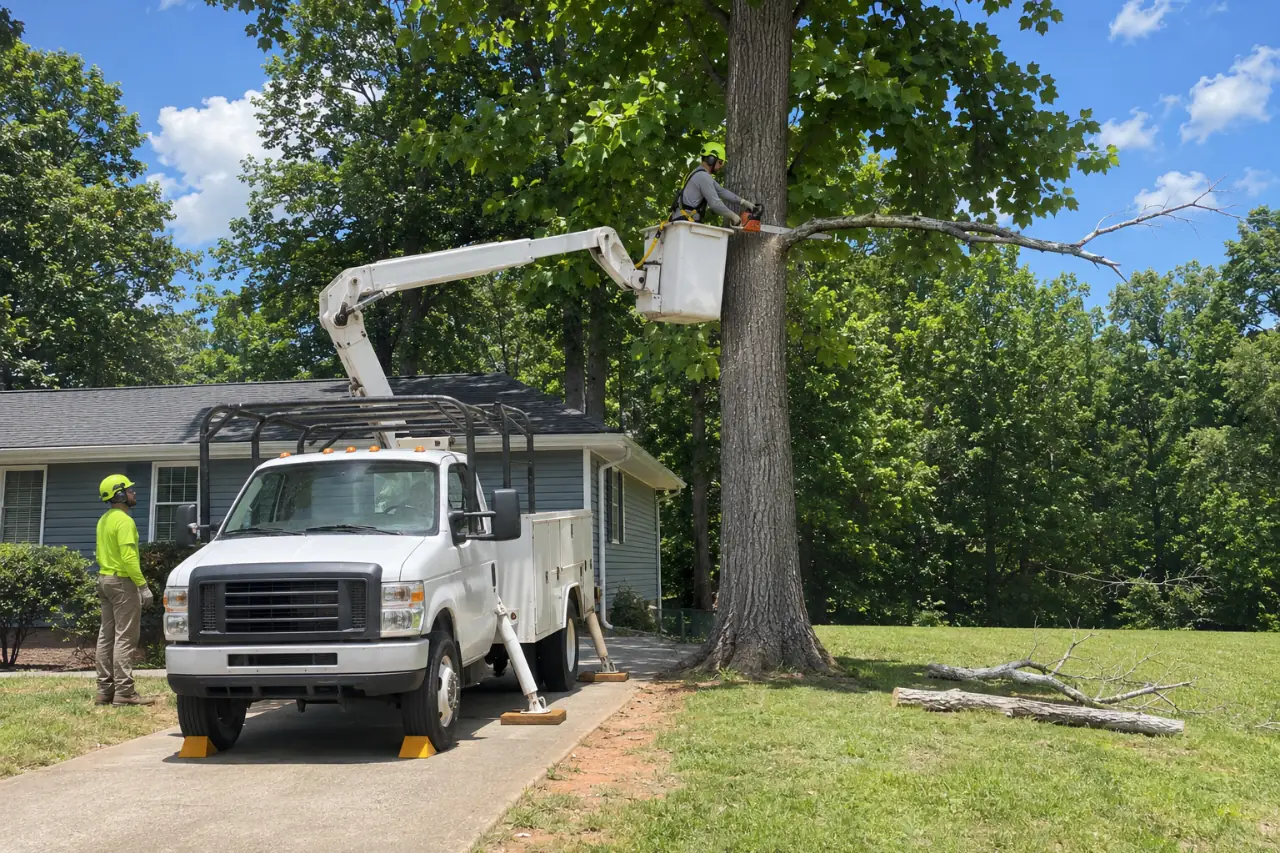
- Limbs are cut back to the trunk or to a side branch, just outside the slight swelling where the limb joins. Cutting flush into the trunk opens a wider wound; leaving a long stub leaves dead wood that rots.
- Heavy limbs are cut in stages, with a small cut underneath first, so the bark doesn't tear down the trunk when the weight drops.
- Only part of the live crown comes off in one visit. Stripping most of the green leaves the tree short of the leaves it feeds on.
- No topping. Cutting a tree's top off to shorten it leaves big stubs that decay and a flush of fast sprouts that are weakly attached. If a tree is truly too tall for its spot, removal is usually the honest answer.
- No climbing spikes on a tree that is staying. Spikes punch holes through the bark all the way up; they belong on removals.
Pines and hardwoods need different trims
Pines are the tall evergreens over many Villa Rica roofs. They drop their lower limbs naturally as they grow, so a pine trim is mostly removing dead and broken branches and any live limbs that reach the roof. Thinning a pine's small green crown does little good.
Oaks, hickories, sweetgums and tulip poplars, the overstory hardwoods named in the city's own zoning code, spread wide. A hardwood trim is more about reducing a heavy limb's length so it carries less weight, clearing the roof, and removing crossing or rubbing branches. On oaks, look for the crusty fungal patches of hypoxylon canker on bark that has fallen away. UGA Extension says the fungus attacks trees weakened by heat and drought and advises removing infected limbs or trees once they become hazardous.
For trees that are browning or dropping limbs after the 2026 drought, the drought-stressed trees page goes into the signs.
Limbs near power lines
This is where trimming gets regulated. Under Georgia's High-Voltage Safety Act, as Georgia Power summarizes it, the person responsible for any work within 10 feet of a line over 750 volts must give notice through 811 (or the Utilities Protection Center at 1-800-282-7411) at least 72 hours ahead, not counting weekends and holidays. The line owner then guards against contact by de-energizing, moving or covering the line. Violations are misdemeanors with fines of $1,000, or $3,000 for a repeat (checked Nov 18, 2026).
In practice:
- The main lines on the poles belong to the electric company. Depending on the street, that's Georgia Power, Carroll EMC or GreyStone Power, the three that serve Carroll County; the name is on your bill. Georgia Power says the need to prune near its lines depends on a tree's growth rate and how close it is to the line, and warns against anyone climbing a tree that stands near its lines (checked Nov 18, 2026).
- The service drop, the single wire running to your siding, is where homeowner trims and utility rules meet. Call the electric company before any limb near it is cut, and ask what they will do and what they require before a private crew works there.
- Never have anyone cut a limb that is touching a line. Call the utility.
When to schedule a trim
Dead wood can come out any time of year, and sooner is better: the tree-dropping storms on record near Villa Rica came in May, September, December and January. Late fall and winter, with the hardwoods bare, make it easier to see the structure of an oak or poplar and to spot dead branches. After a storm, hung limbs are urgent; a full shaping trim can wait.
What trimming costs
| Tree | Typical range |
|---|---|
| Atlanta, any tree | $379 to $565 |
| Under 30 ft | $85 to $415 |
| 30 to 60 ft | $215 to $790 |
| Over 60 ft | $475 to $1,835 |
| Pine | $210 to $1,630 |
| Oak | $230 to $1,480 |
A climber working over a roof, a tree near a line that needs utility coordination, and hauling away the brush all push the price toward the top. See the full cost page.
Trimming questions
Can one trim fix a tree leaning toward the house?
Taking weight off the leaning side can help a sound tree. It does nothing for a tree that is leaning because its roots are failing. If the soil is heaving on the far side, have the tree looked at for removal.
Will the electric company trim my trees?
They trim to protect their own lines, on their own schedule. They do not shape yard trees. Georgia Power says debris from its planned trimming is removed as soon as possible, but cleanup after storms is up to the property owner.
How often should a big oak be trimmed?
There is no fixed calendar. Have it checked after any storm that drops limbs in the neighborhood, and whenever dead branches show in the crown.
Can the brush be left for the city?
Not if a contractor cut it. Villa Rica's curbside pickup page lists materials removed by contractors among what city crews won't pick up (City of Villa Rica, checked Nov 18, 2026). Make haul-off part of the price.