
What the weather service recorded
The weather service's Peachtree City office issues drought information statements while a drought lasts. Its May 14, 2026 statement put Carroll and Douglas counties in D3, Extreme Drought, along with Fulton, Cobb, DeKalb, Gwinnett and other metro Atlanta counties, said most of the state still had deficits of 8 to 15 inches since Oct. 1, and noted that 60-day rainfall was under 60% of normal at most places. By July 9, 2026 both counties had improved to D1, Moderate Drought, with rainfall across the region still under 75% of normal (checked Nov 18, 2026).
Drought damage doesn't always show right away. The Forestry Commission's beetle guidance and UGA Extension's oak disease guide both describe the same pattern: a weakened tree becomes the target, and the insects or fungi that move in are what finish it. A tree that got through the dry spring can still decline after the rain comes back.
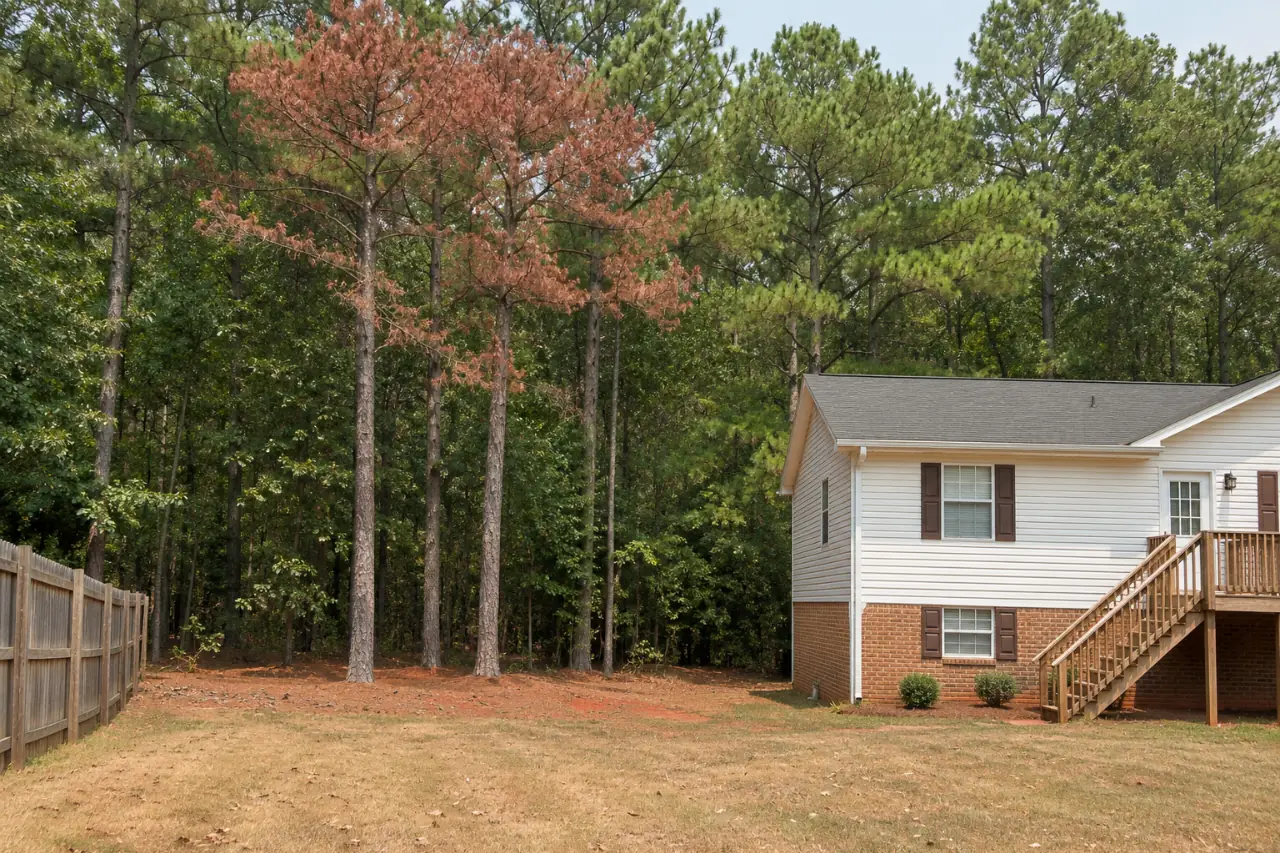
Pines: bark beetle signs
Loblolly, shortleaf and Virginia pines are the three species the Georgia Forestry Commission lists as most susceptible to the southern pine beetle (checked Nov 18, 2026). What to look for:
- Pitch tubes: small lumps of sap pushed out where a beetle has bored through the bark. The Forestry Commission notes that drought-stressed trees may not make them, so their absence doesn't clear a tree.
- Boring dust or fine sawdust on the bark or around the base of the trunk.
- Needles turning pale green, then yellow, then red, then brown. A University of Georgia report on bark beetles noted back in 1998 that by the time the needles yellow, it is usually too late to save the tree.
- Small round exit holes, about 1/16 inch, and dead or faded branch tips, which the Forestry Commission lists as Ips beetle signs.
Southern pine beetles build winding S-shaped galleries under the bark that girdle the tree, and carry a blue-stain fungus that clogs the wood that moves water. Outbreaks can run one to three years. The Forestry Commission's control method is to cut and remove infested trees, plus a buffer of uninfested trees at least as wide as the infested trees are tall; it generally doesn't recommend insecticides.
In a yard, a beetle-killed pine near the house should come down, and the pines beside it deserve a look during the same visit.
Oaks: hypoxylon canker and decay
UGA Extension's guide to oak diseases describes hypoxylon cankers as opportunists that attack trees weakened by heat and drought. The fungus can live unnoticed in healthy trees and take hold once a tree is stressed. The signs:
- Leaves yellowing and wilting, often the first thing noticed.
- Bark falling off in patches to show a hard, crusty fungal mat underneath.
- Sapwood that has turned tan to light brown with a black border.
The guide's advice is to remove infected limbs or trees once they become hazardous to property or people. It also describes heart rot, a white rot of the heartwood that is most likely in trees weakened by drought or wounds, and Armillaria root rot, which makes the wood spongy and can't be eradicated. A large oak with decay low on the trunk or in the root flare is the kind of tree that fails whole in a storm.
Ash trees and the emerald ash borer
The Georgia Forestry Commission's county list has the emerald ash borer confirmed in both Carroll and Douglas counties, as well as Paulding and Haralson (table dated Sept. 22, 2023). The beetle was first found in Georgia in DeKalb and Fulton counties in July 2013, and the Forestry Commission notes it attacks both vigorous and weakened ash. An ash with a thinning crown should be looked at before it gets brittle.
When a stressed tree needs to come down
Not every tree that looked rough in a dry summer is dying. One that put out a full set of leaves this year and has no beetle or fungus signs may recover. Signs that point toward removal:
- A pine with a red or brown crown, or pitch tubes and boring dust up and down the trunk.
- An oak with fungal mats showing under fallen bark, or large dead limbs throughout the crown.
- Dead wood over a roof, a driveway, a deck or a play set. Dead limbs over places people use are the urgent part even if the tree itself might live; those can be handled by trimming.
- Mushrooms or conks at the base, or soft, spongy wood in the root flare.
The sooner a dead pine comes down, the easier it is. Dry, beetle-killed wood breaks unpredictably, which makes climbing and rigging slower.
What to do with beetle-killed wood
The Georgia Forestry Commission notes that broken limbs, wounds and slash serve as breeding material for Ips beetles, and advises salvaging or removing damaged trees quickly. In practice:
- Don't leave fresh pine tops and limbs piled under the remaining pines. Have them chipped or hauled.
- Pine rounds kept for firewood are better stacked away from living pines.
- Brush can't be burned from May 1 to Sept. 30 in Carroll and Douglas counties under the state's summer burn ban.
Questions about dying trees
Can watering save a drought-stressed tree?
A slow, deep soak under the outer canopy during a dry spell helps a tree that is still alive and has no beetles in it. It won't save a pine with beetles already under the bark.
If one pine has beetles, will the rest die?
Not necessarily, but southern pine beetle spreads from tree to tree, which is why the Forestry Commission's method cuts a buffer of healthy trees around an active spot. Have the neighboring pines checked.
Who can confirm what's wrong with my tree?
Your county's UGA Extension office and the Georgia Forestry Commission both answer tree health questions. A contractor visiting for a removal can also point out the signs above.
Does homeowners insurance pay to remove a dead tree?
Generally not before it falls. Taking down a dying tree on purpose is usually the owner's cost; check your policy.