
Signs a Villa Rica tree has reached the end
Most removals around here start with one of a handful of things a homeowner can see from the ground:
- A crown that has thinned or browned from the top down. On a pine, needles that fade from green to yellow to red to brown point to bark beetles; the Georgia Forestry Commission lists that color change as a sign of southern pine beetle (checked Nov 18, 2026). Once it shows, the tree is usually past saving.
- Fine sawdust at the base or small round holes in the bark. The Forestry Commission lists both as signs of Ips engraver beetles, which breed in storm-broken and stressed pines.
- Bark sloughing off an oak to show hard, crusty patches underneath. UGA Extension describes these fungal mats as hypoxylon canker, which moves into oaks weakened by heat and drought. Its advice is to remove infected limbs or trees once they become hazardous to property or people.
- A new lean, or a mound of soil lifting on one side of the trunk. In wet clay after days of rain, a heaving root plate is a warning that the next wind could tip the whole tree.
- A split where two big trunks meet, or a crack down the trunk. These rarely close up and tend to open further in wind.
The drought that ran from last fall into this summer makes the first three more common. The National Weather Service had both Carroll and Douglas counties in Extreme Drought on May 14, 2026. More on that on the drought-stressed trees page.
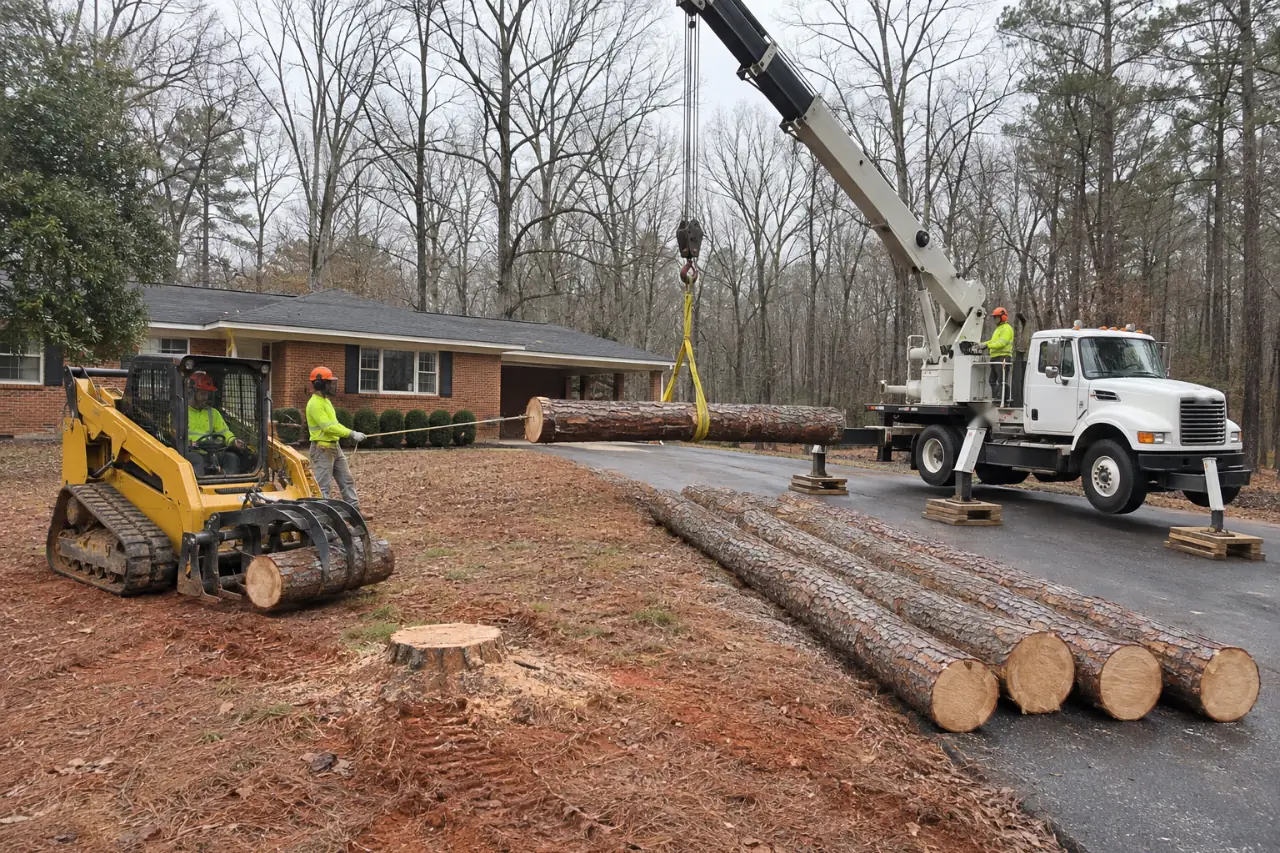
How a tall pine comes down beside a house
Loblolly pines in older Villa Rica yards often top out well above the roofline and stand within a few yards of the house. A tree like that can't simply be notched and dropped. The usual sequence:
- A climber or a bucket truck goes up and takes the limbs off first, lowering the heavy ones on ropes run through a block or around the trunk so they don't swing into the house.
- The bare trunk is then taken down from the top in sections, each piece cut short enough to be lowered or dropped into a clear landing spot.
- When there is open ground in the direction it needs to fall, the last tall section of trunk may be felled whole.
- Where no truck can reach the backyard and nothing can be dropped, a crane lifts sections over the house. HomeGuide lists crane assistance at $500 to $2,500 per day added to the base price (checked Nov 18, 2026).
Hardwoods are handled the same way, with more rigging. A big oak's spreading limbs weigh far more than a pine's, and each one has to be lowered on a rope instead of dropped.
Red clay, wet yards and access
Villa Rica sits in Georgia's Piedmont, where long weathering left behind clay colored red by iron oxides, according to the New Georgia Encyclopedia. That soil matters on a removal day in three ways:
- It ruts. A loaded truck or a stump grinder crossing a soaked lawn leaves tracks. Ask whether the crew lays mats or waits for the ground to firm up.
- It washes. The same encyclopedia notes that Piedmont soil erodes easily once vegetation is stripped. On a sloped lot, a removal that bares a bank can start a gully.
- It shapes how trees fail in storms. When clay is soaked, a tree can tip over roots and all, lifting a plate of red soil and leaving a hole where it stood. The weather service's surveys around here list trees both snapped and uprooted.
Before the visit, think about how a truck gets to the tree: gate widths, septic fields, a soft spot by the downspout. Those details change the price.
What happens to the wood and brush
Settle this before work starts, because a tall pine leaves a lot behind. The usual choices are:
- Hauled away. Limbs go through the chipper and the trunk wood leaves on a truck or trailer.
- Trunk cut into rounds and left. Common when someone wants firewood. Brush is still chipped and hauled.
- Everything left on site. The lowest price, but you are left with the pile.
The city's curbside service is not a substitute for haul-off. Villa Rica's curbside pickup page lists stumps and trees, and materials removed by contractors, among what city crews won't pick up (City of Villa Rica, checked Nov 18, 2026). Carroll County's transfer station at 439 Simonton Mill Road in Carrollton accepts limbs and yard debris kept separate from other waste for $54 a ton, with a $25 minimum for loads up to 800 pounds (checked Nov 18, 2026).
Burning is limited too. Georgia's summer ban on burning yard and land-clearing debris runs May 1 to Sept. 30 in both Carroll and Douglas counties (Georgia EPD, checked Nov 18, 2026). For pines the Forestry Commission has a further reason not to leave a pile sitting: broken limbs and slash are breeding material for Ips beetles.
Does the city need to sign off?
For an existing home, no. Villa Rica's zoning code requires a Land Disturbance Permit to remove protected trees "in preparation for development activity," and lists trees "on developed single-family lots" among the exemptions, along with dead, diseased or damaged trees and trees that are an imminent danger (Villa Rica zoning ordinance, Appendix B, Sec. 7.05(5)(f)(i), checked Nov 18, 2026). If you are clearing ground to build an addition, a garage or a new house, talk to the city's Community Development department first. The full reading is on the Villa Rica tree permit page.
Power lines, the road and the neighbors
Georgia's High-Voltage Safety Act requires whoever is responsible for the work to give notice through 811 at least 72 hours ahead, not counting weekends and holidays, before any work within 10 feet of a line carrying more than 750 volts. The line owner then guards the line. Breaking the rule is a misdemeanor with a $1,000 fine for a first offense (Georgia Power summary of the law, checked Nov 18, 2026). That is why a removal under the street line takes scheduling.
If the tree leans over a neighbor's yard, tell them before the crew arrives; limbs may need to be lowered on their side. If it stands near the street, ask the city whether it sits in the public right-of-way before anyone cuts.
What removal costs
| Tree height | Low end | High end |
|---|---|---|
| Under 30 feet | $285 | $435 |
| 30 to 60 feet | $435 | $870 |
| 60 to 80 feet | $870 | $1,160 |
| Taller than 80 feet | $1,160 | $2,000 |
For the Atlanta area specifically, HomeGuide's guide runs from $330 up to $2,250 a tree (checked Nov 18, 2026). A pine over a roof with no truck access lands at the top of these ranges or above them. The cost page breaks the numbers down.
Removal questions
Does the stump come out at the same time?
Only if you ask. Removal normally leaves a stump a few inches above the ground. Grinding is a separate line on the price; see stump grinding in Villa Rica.
Do I need to be home?
Not always, but be there for the walk-around before work starts so you can point out the septic lines, sprinkler heads, the dog fence wire and anything you want left alone.
The tree is dead. Is it safer to wait?
No. Dead wood gets brittle as it dries, which makes climbing and rigging it harder, and a dead pine is a target for beetles that can move into healthy pines nearby.
It's my neighbor's tree hanging over my roof. Who pays?
Talk to the neighbor first. If it falls on your house, Consumer Reports says to start with your own homeowners insurance even when the tree was rooted next door.