
How a stump gets ground
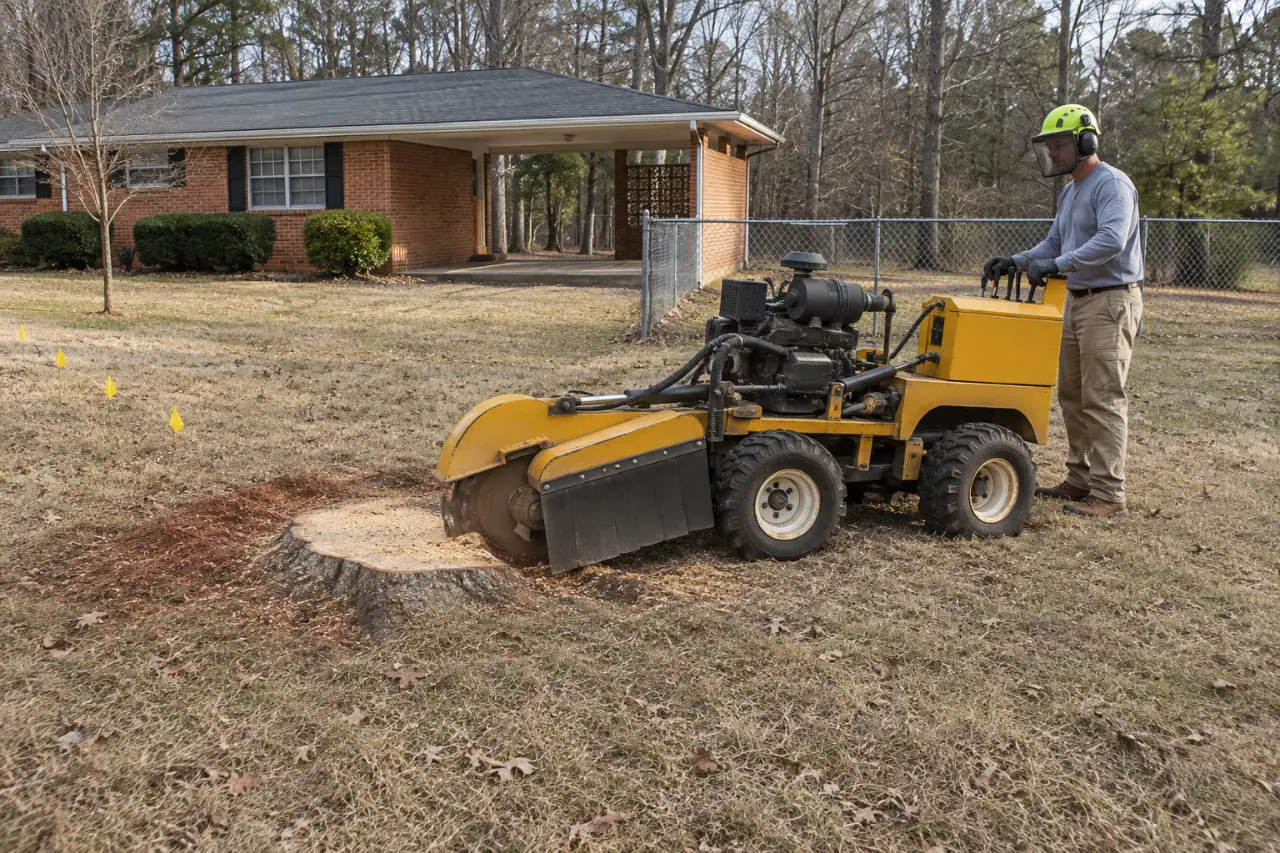
The grinder is set beside the stump, and the operator sweeps the cutting wheel back and forth across the top, lowering it a little with each pass until the stump is gone below grade. Then the big surface roots running off the stump are ground out as far as was agreed. On small jobs the machine is a walk-behind unit narrow enough for most backyard gates; big hardwood stumps take a larger, heavier machine, which needs firm ground and a wider path.
Ask three things before the work starts:
- How deep? A few inches below the soil is enough to lay sod. Planting a new tree or setting a fence post in the same spot calls for going deeper.
- How far out on the roots? Surface roots that run toward the driveway or across the mowing path can be ground too, but each foot is more machine time.
- What happens to the chips? Left in the hole, raked out as mulch, or hauled away. When cleanup is billed on its own, HomeGuide puts it at $2 to $4 for each inch the stump measures across (checked Nov 18, 2026).
Georgia 811 before the grinder goes in
Georgia 811 tells homeowners and excavators to submit a locate request at least three business days before digging, either by calling 811 or online. Each utility then marks its own lines, and the request expires after 30 calendar days. Georgia 811 also describes a tolerance zone of 18 inches on either side of a marked line (checked Nov 18, 2026). The locate service is funded by utility companies.
A grinder's wheel can reach well below the lawn, and many Villa Rica yards have something buried near the old tree: the gas line, the cable or fiber drop, the water line from the street. Utilities mark their own lines; the homeowner's private lines, like a wire to a shed light or the irrigation, are not something a utility will know about. Point those out before the wheel starts.
What the yard looks like afterward
A ground stump leaves a shallow crater filled with a mix of chips and soil. In Villa Rica that soil is usually red clay, so the pile comes out orange-brown rather than the light tan of pure wood chips. Over the next year the chips rot and the mound settles, often leaving a dip. Common fixes:
- Rake most of the chips out, fill with topsoil, tamp, then seed or sod.
- Leave the chips in a bed as mulch, away from the house foundation.
- Top up the low spot again after a few months of settling.
Fresh chips tie up nitrogen in the soil as they break down, so grass seeded straight into a chip pile often comes in thin and yellow. Clearing most of them out first gives a better lawn.
Pine stumps and hardwood stumps
A cut pine generally doesn't sprout back from its stump, so the stump simply dies and rots over the years if left alone. Pine stumps, though, are full of resin, and freshly cut pine wood is the kind of material bark beetles use. The Georgia Forestry Commission notes that broken limbs, wounds and logging slash serve as breeding material for Ips beetles, and advises removing damaged pines quickly (checked Nov 18, 2026).
Some hardwoods send up sprouts from the stump or the roots after the trunk is cut. Grinding the stump, and the root flare around it, is the usual way to stop that.
When leaving the stump is fine
Grinding isn't always needed. A stump at the edge of the woods, out of the mowing path, can be cut low and left to rot. Leave it if:
- it isn't in the way of a mower, a path, a fence line or a planned driveway,
- it's a pine, which generally won't sprout,
- and nobody will trip over it.
Grind it if you want lawn, a garden bed or a new tree there, or if it is a sprouting hardwood.
What stump grinding costs
| Item | Range | Source |
|---|---|---|
| One medium stump, Atlanta | $109 to $192 | LawnStarter, updated Oct. 5, 2026 |
| Typical job, national | $131 to $438 (average $272) | LawnStarter, updated Oct. 5, 2026 |
| Each inch across the stump base | $2 to $6 | HomeGuide |
| First stump | $120 to $400 | HomeGuide |
| Each additional stump | $30 to $60 | HomeGuide |
| Minimum service charge | $80 to $160 | HomeGuide |
HomeGuide notes that contractors measure the diameter at the base of the trunk, not just the cut top, so a stump that looks like 20 inches may be billed as more. Several stumps in one visit are much cheaper per stump than one at a time. The cost page has the rest of the numbers.
Stump grinding questions
Can the stump be ground the same day the tree comes down?
It can be, if a grinder comes along on removal day and the 811 marks are already down. Ask about it when you book the removal.
Will grinding hurt my foundation or driveway?
The wheel only cuts what it touches, but roots under a slab are out of its reach. Grinding right against concrete is slow, careful work and may cost more.
Can I plant a new tree in the same spot?
Better a few feet to one side. The old spot is full of decaying chips and roots for years.
Is a ground stump a termite risk?
Rotting wood in the soil can attract wood-eating insects. Raking out most of the chips and not piling them against the house reduces the risk.