
What Douglasville's code says about trees
Douglasville's Unified Development Ordinance handles trees in Section 8.02, which the city amended by Ordinance O-2022-8 in 2022. Read from the city's published copy of the ordinance (checked Nov 18, 2026), it says:
- What it covers: the tree conservation part says its requirements "shall apply to any activity on real property within the City of Douglasville," and its list of examples starts with "Single-family and two-family lots which are new or expanded," followed by new subdivisions and other new development. (A separate line in the section's landscaping and buffer part, "This section shall not apply to single family or two-family dwellings," is about required landscaping, not tree conservation.)
- Exemptions: among them, removing diseased or infested trees "upon the verification of the community development director or other qualified forestry professional," removing trees that have become, or threaten to become, a danger to life or property, again once a city director or a qualified forestry professional verifies it, and utility and government work in rights-of-way.
- Specimen trees: existing specimen trees "shall not be removed from property other than single-family residential property" unless development would cause irreparable damage to their critical root zones.
- Tree density: residential development has to reach 18 tree units per acre; a developer can pay into a Tree Replacement Fund at 125% of the cost of buying, delivering and planting the trees.
The section doesn't lay out a separate permit for taking an ordinary tree out of an existing home's yard. Because its coverage is written broadly and its exemptions for sick and dangerous trees call for verification, a call to Douglasville's Community Development department before a big removal heads off any misunderstanding.
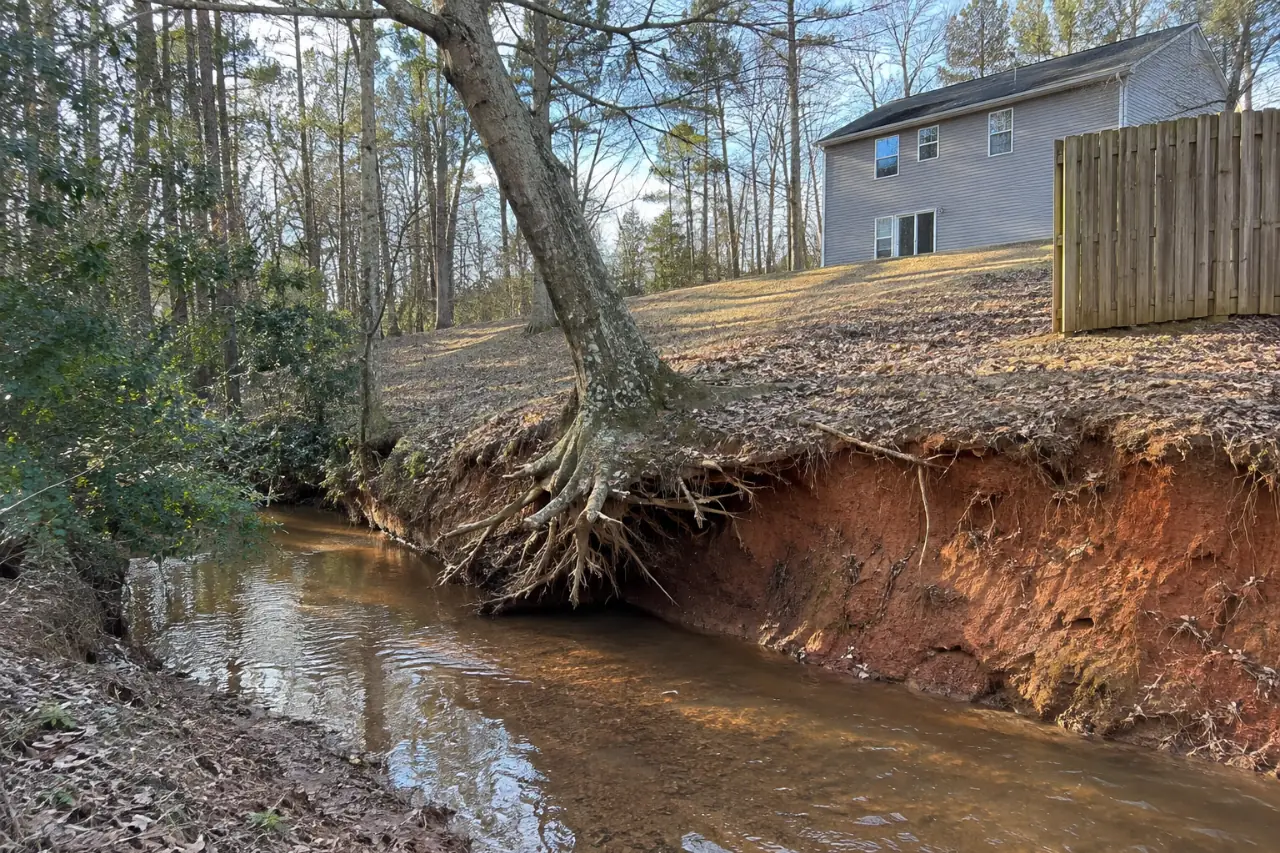
The 50-foot stream buffer
Section 9.01, which applies to land development on property with a stream protection area, says: "An undisturbed natural vegetative stream buffer shall be maintained for 50 feet," measured from the top of the stream bank, with a further 25-foot setback where no pavement or other impervious cover is allowed (checked Nov 18, 2026). The Dog River and Sweetwater Creek, both named in the federal account of the 2009 flood below, run through Douglas County. If a tree you want gone stands within 50 feet of a creek bank, treat it as a question for the city first, not a decision for the crew on the day.
The same article requires anyone harvesting standing timber to notify the city's development official before cutting, with fines up to $500 for skipping the notice (Sec. 9.03). That's aimed at timber cutting, not yard trees. Article 9 was read from a published copy of the code; confirm current text with the city.
May 3, 2021: trees on homes and a death downtown
On the morning of May 3, 2021, an EF-1 tornado with 90 mph winds touched down about 10 a.m. near Bill Arp and ran 1.5 miles toward Chapel Hill. The National Weather Service survey found that at least 10 homes had trees fall on them, and pictured a large pine down on a home on Cherry Dale Drive.
The same morning, on Campbellton Street between Woodrow Avenue and Spring Street in downtown Douglasville, high winds brought a tree down onto a driver's vehicle, leaving power lines and the tree on top of it. Firefighters had to extricate him, and he died (Atlanta Journal-Constitution and Fox 5 Atlanta, May 3, 2021). A tall tree beside a street or driveway that is leaning, hollow or dying is exactly the kind worth having looked at before the next storm.
September 2009: the Dog River and Sweetwater Creek
The U.S. Geological Survey's account of the September 2009 flood names the Dog River basin in Douglas County as the hardest-hit area. On Sept. 21, the Dog River at GA 5 near Fairplay crested at 33.83 feet with a flow of about 59,900 cubic feet per second, almost six times the 100-year flood. The next day Sweetwater Creek near Austell passed the 500-year mark, and Interstate 20 was closed for more than a day. Across the region, 11 people died, many in cars on flooded roads, and flood claims came to nearly $220 million. Douglas was one of the four counties named in the federal disaster declaration of Sept. 24, 2009, FEMA-1858-DR.
For trees, the lesson of 2009 is about soaked ground. Waterlogged clay gives roots less grip, so big trees along creeks and in low yards are worth a look after high water, especially any that have started to lean.
Power lines in Douglasville
The City of Douglasville says electric service in the city comes from either GreyStone Power, an electric cooperative, or Georgia Power: most of the city is served by Georgia Power, and most of Douglas County by GreyStone (checked Nov 18, 2026). The company on your bill is the one to call about a limb on a line or a tree across the service wire. Georgia's High-Voltage Safety Act requires 72 hours' notice through 811 before work within 10 feet of a line over 750 volts (Georgia Power's summary of the law, checked Nov 18, 2026), and Georgia Power reminds customers to treat any downed line as energized.
Burning, debris and pests
- Burning: Douglas County is in Georgia's summer burn ban, May 1 to Sept. 30, for yard and land-clearing debris (Georgia EPD, checked Nov 18, 2026). The rest of the year the Georgia Forestry Commission's rules for hand-piled leaves and limbs apply, and local ordinances may add limits.
- Drought: Douglas County was in Extreme Drought (D3) on May 14, 2026, per the weather service. See dying trees after the drought.
- Emerald ash borer: confirmed in Douglas County (Georgia Forestry Commission county table dated Sept. 22, 2023).
- Locates: Georgia 811 asks for a request at least three business days before digging, which includes grinding stumps below ground (checked Nov 18, 2026).
Douglasville questions
Is Douglasville's tree rule stricter than Villa Rica's?
Different more than stricter. Villa Rica's code exempts developed single-family lots outright. Douglasville's has no such plain exemption, asks for verification before diseased or dangerous trees come out, and adds a 50-foot stream buffer. See Villa Rica's permit rule to set them side by side.
The tree is in my backyard, next to a creek. Can it come down?
Ask the city first. If it is within 50 feet of the top of the bank, it sits in the undisturbed buffer.
What if the tree is dead or diseased?
Douglasville's exemption for diseased or infested trees mentions verification by the community development director or a qualified forestry professional. Have that conversation before cutting.
Does the same contractor come out to Douglasville?
Yes. Requests from Douglasville go to the same independent local contractor.