
The storms that dropped trees here
These are the recorded storms that put trees on houses, cars and roads in and around Villa Rica, plus this year's north Georgia ice storm and the 2009 flood:
- Dec. 31, 2021, Temple to Villa Rica. An EF-1 tornado with peak winds of 95 mph ran 2.75 miles, up to 150 yards wide, from 2 miles east of Temple to 3 miles west-northwest of Villa Rica between 5:32 and 5:45 p.m. The weather service found trees snapped or uprooted between Wilton Smith Road and Old Villa Rica Road, more trees uprooted or snapped along Long Branch and Cown roads, many of them large pines, a barn ripped apart, and a home near Astin Creek Road with roof damage from a falling tree. Nobody was hurt (NWS Peachtree City survey).
- May 3, 2021, Bill Arp, Douglas County. An EF-1 with 90 mph winds touched down about 10 a.m. near Bill Arp and ran 1.5 miles toward Chapel Hill. The survey found at least 10 homes with trees on them and a large pine down on a home on Cherry Dale Drive (NWS Peachtree City). That morning, a driver was killed when a tree brought down by the storm fell on his vehicle on Campbellton Street in Douglasville, with power lines across it (Atlanta Journal-Constitution, May 3, 2021).
- Jan. 10, 2026, southern Carroll County. An EF-1 with winds up to 95 mph ran about a mile east from near Lake Circle and Staples Dairy Road and uprooted many trees (Atlanta Journal-Constitution, citing the weather service and the Carroll County Sheriff's Office of Emergency Management).
- Jan. 24–25, 2026, north Georgia. North Georgia's first major ice storm since 2014, with at least half an inch of ice in the hardest-hit areas and massive power outages (WSB-TV, Jan. 29, 2026). The Georgia Forestry Commission's timber survey found the damage mostly in the northeast Georgia mountains, with Virginia pine the species most affected; it did not list Carroll or Douglas County.
- Sept. 2009, the Dog River and Sweetwater Creek. Rain from Sept. 16 to 22 produced flooding the U.S. Geological Survey called epic. The Dog River in Douglas County crested at almost six times its 100-year flow, 11 people died across the region, and flood claims came to nearly $220 million.
Between January 2015 and March 2019 alone, the weather service's report for Carroll County listed 2 tornadoes, 10 damaging wind events and 4 winter storms (Carroll County hazard mitigation plan, Appendix F, checked Nov 18, 2026).
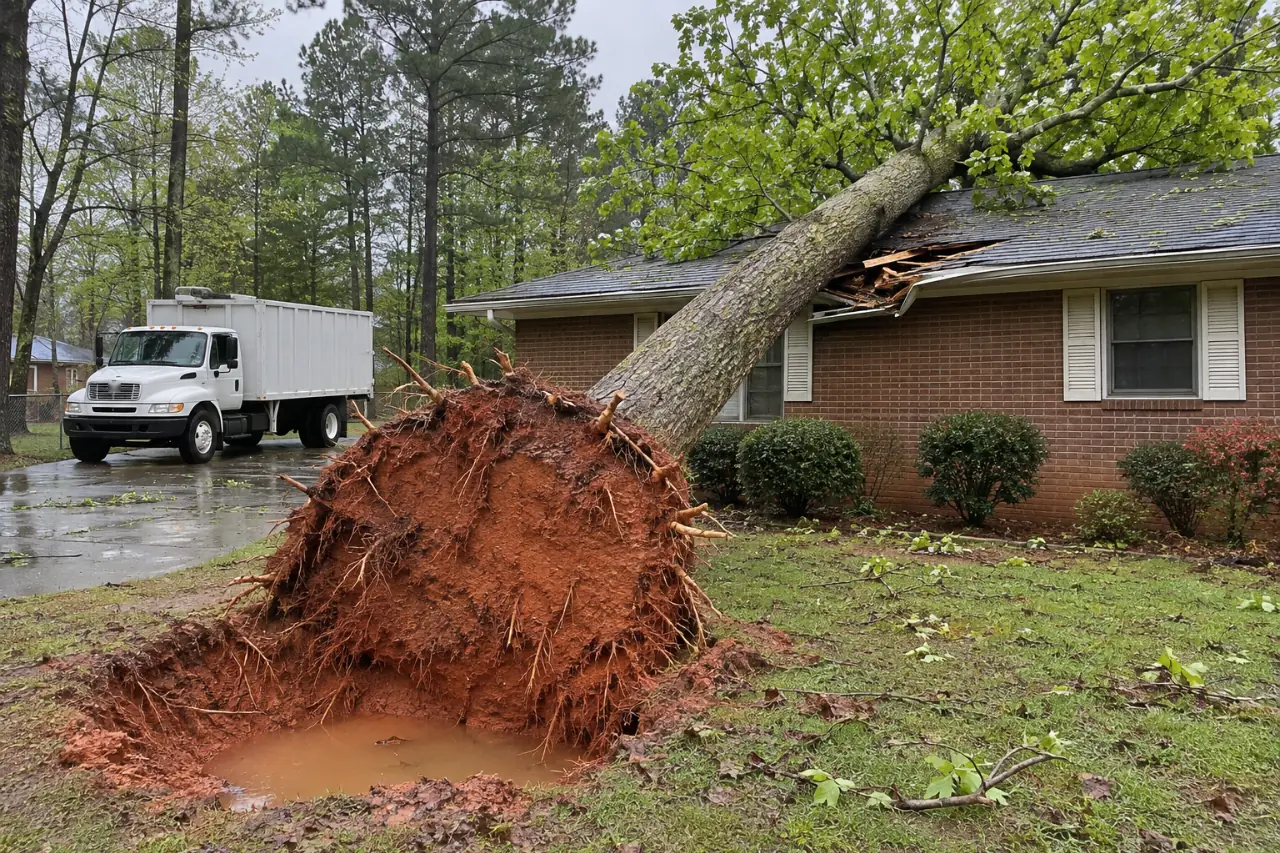
Right after the tree hits: what to do, in order
- Get people clear. Keep everyone, pets included, away from the tree, anything it is touching and any hanging limbs above it. A tree on a roof can shift.
- Look for wires before you look at anything else. Georgia Power says to assume a downed line is energized and stay away, and to call immediately if a fallen tree is in contact with a power line (checked Nov 18, 2026). Call whichever utility is on your bill: Georgia Power, Carroll EMC or GreyStone Power.
- Shut off what you can safely. If the tree broke a gas line or you smell gas, leave and call the gas company and 911 from a distance.
- Take photos and video of the tree, where it hit, the root plate or broken trunk, and the inside of the house if the roof was breached. Your insurer will ask.
- Call your insurer before agreeing to any repair contract.
- Then call for the tree work. A tree resting on a roof should come off before rain gets in, but only once nobody is near a live wire.
Trees on power lines
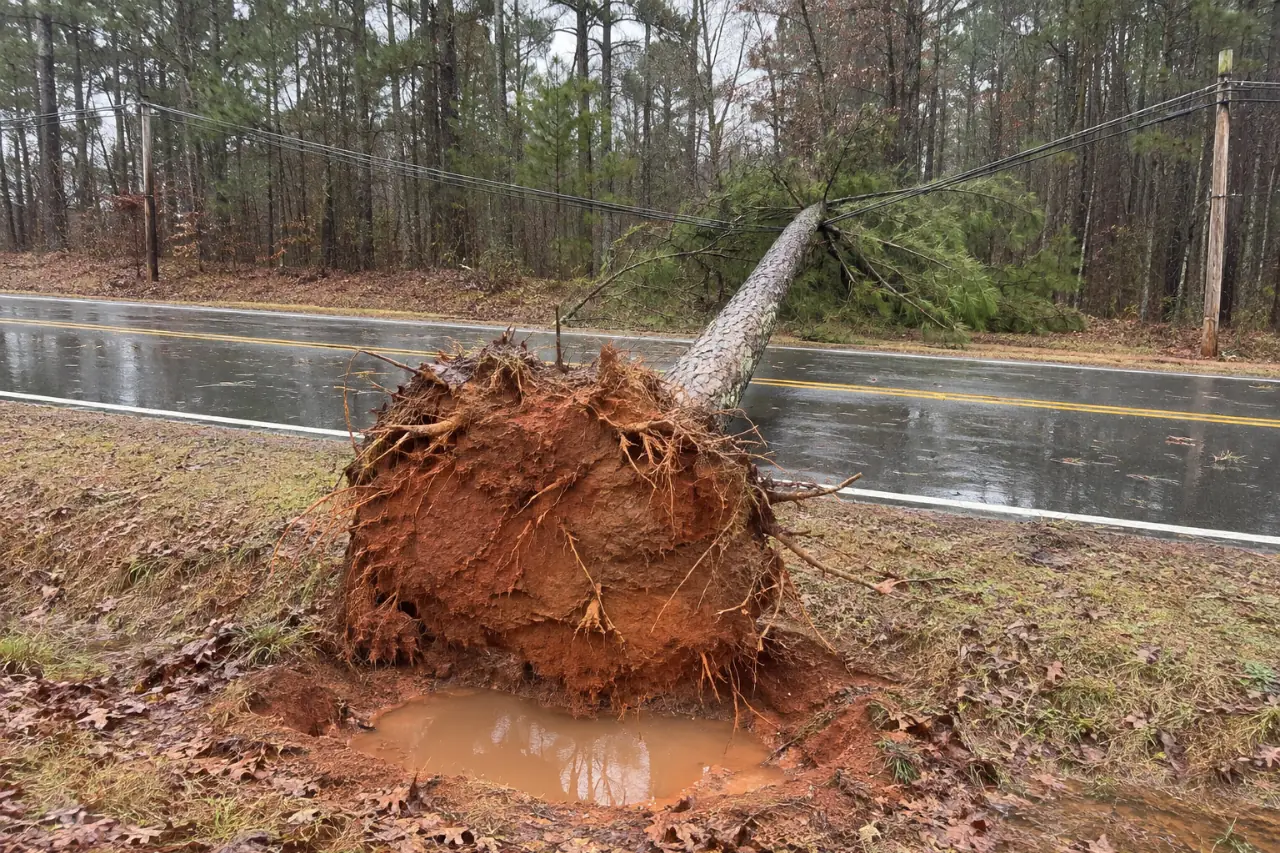
Do not touch the tree, the line or anything in contact with them, and don't let anyone with a chainsaw near it until the utility has made the line safe. Georgia Power says plainly that nobody should be up a tree that stands near its lines. Under Georgia's High-Voltage Safety Act, any work within 10 feet of a line over 750 volts requires notice through 811 and safeguards from the line owner first (Georgia Power's summary of the law, checked Nov 18, 2026). Once the utility clears the line, the tree work can go ahead. Georgia Power also says that after storms, vegetation debris cleanup is the property owner's responsibility, so the wood left behind is yours to deal with.
Homeowners insurance and fallen trees
- Tree hits the house, garage or another covered structure: your policy may pay for repairs and for removing the tree, minus the deductible. Consumer Reports, citing the Insurance Information Institute, says insurers generally cap tree removal at $500 or $1,000 (checked Nov 18, 2026).
- Neighbor's tree hits your house: start with your own insurer anyway. It may later seek repayment from the neighbor's insurer.
- Tree falls in the yard and hits nothing: generally your own cost, with exceptions some insurers make for a blocked driveway.
Georgia's Consumer Protection Division says to talk to your insurance company before committing to any storm-related repairs, and to be skeptical of any contractor who offers to pay your insurance deductible (alert updated Oct. 29, 2024).
Storm-repair scams after a big blow
Georgia's Attorney General's Consumer Protection Division publishes advice for hiring after storms, and warns that scammers may "charge exorbitant prices for tree removal." Its advice (checked Nov 18, 2026):
- Avoid door-to-door offers for repair work.
- Insist on a written contract with all guarantees, warranties and promises in it, and start and completion dates written in.
- Steer clear of anyone who wants full payment up front or will only take cash; consider paying no more than one-third as a down payment.
- If you sign a contract to fix or limit damage to your home less than a year after a natural disaster, and your insurer later says in writing that all or part of the claim isn't covered, Georgia law gives you until midnight of the fifth business day after that notice to cancel (in effect since July 1, 2025).
Report fraud or price gouging to the Consumer Protection Division at 404-651-8600 or 1-800-869-1123 (checked Nov 18, 2026).
After the cleanup: pines left standing
A storm that breaks pines leaves an opening for bark beetles. The Georgia Forestry Commission says injuries signal to beetles that a tree is vulnerable, that broken limbs, wounds and slash serve as breeding material for Ips beetles, and that damaged trees should be salvaged or removed quickly. Watch the pines that stayed up for the next few months: yellowing crowns that turn red and brown, fine sawdust on the bark, small round holes. The drought-stressed trees page covers those signs.
Leftover brush can't be burned from May 1 to Sept. 30 in Carroll or Douglas County. Outside those months, the Forestry Commission handles storm-debris burns separately from ordinary yard debris; its permit line is 1-800-GA-TREES (checked Nov 18, 2026).
Storm questions
A tree is leaning against the house but nothing is broken. Can it wait?
Not long. A tree resting on a roof is putting weight on rafters that weren't built for it, and the next wind moves it. Have it looked at soon.
The city is picking up storm debris. Will they take my tree?
After big storms cities sometimes run special pickups, with their own rules. Outside of those, Villa Rica's curbside pickup page lists stumps and trees, and materials removed by contractors, among what city crews won't pick up, though limbs smaller than 10 inches in diameter are on its pickup list (City of Villa Rica, checked Nov 18, 2026). Ask the city before stacking anything at the curb.
The tree uprooted and left a hole. What happens to it?
The root plate can be cut off and dropped back into the hole, ground down, or hauled away. Talk it through with the contractor; a big clay root plate is heavy work.
Can I cut it up myself?
Storm trees are often bent under tension and can spring when cut, and some are still hung up in other trees. If it's on anything, or near a wire, leave it to a crew.